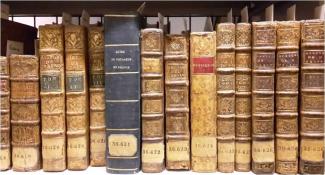
The BU Fenouillères holds the only 2 incunabula in the SCD AMU. They were registered in July 1920 and come from the library of Raymond Bonafous, who was a professor in Aix in 1895.
- Eusebii Caesariensis, Praeparatione evangelica e graeco in latinum a Georgio Trapezunio traducta, Tarvisii, Michael Manzolo, 1480
- Isidore de Séville, Isidori junioris hispalensis Opus etymologicum, s.d.
The BU Fenouillères holds 38 manuscripts, partly inherited from the collections of the Aix Faculty of Theology (abolished in 1885), the others having been received mainly by donation (Bonafous, Paul Mazon, Maurice Mignon, etc.).
The Norton Cru collection (1879-1949), donated by Hélène Vogel-Cru in 1961, comprises over four hundred novels and accounts of the 1914-1918 war. This is the corpus from which Norton CRU, a former poilu, wrote Témoins (1929), a work that gave rise to a lively controversy over the historical value of "war testimony". The Norton CRU collection includes other documents, which have been inventoried: critical articles on Témoins, French and foreign press, critical articles on works belonging to the corpus, and staff maps.
The Antonin Lavergne (1863-1941) collection: correspondence and books from the library of a schoolteacher best known for his novel Jean Coste ou l'instituteur du village (Jean Coste or the Village Schoolteacher), which made a big impact at the time by describing the difficult living and working conditions of the Republic's Hussards noirs. The publication of Lavergne's novel in Cahiers de la Quinzaine gave Charles Péguy the opportunity to write his De Jean Coste. Lavergne's novel has been the subject of numerous studies, including one by Anne ROCHE, who republished it in 1975. Antonin Lavergne's library is essentially made up of literature, of novels whose authors have now fallen into oblivion. But there are also a dozen works by Gustave Hervé (1871-1944), author of pacifist history books before becoming an ardent patriot, and well known to historians of the social movement.
The research area devoted to the work of GAO XINGJIAN has brought together, thanks to a donation from the 2000 Nobel Literature Prize winner, books, unpublished photos, lithographs, posters, manuscripts and an original painting.
The "CollEX" research space includes some rare and precious works among its research-level collections on two themes: the history of French colonization and the history of the Mediterranean East in the Ottoman period.